

Trace Evidence Examination
Examination of soil, paint, glass, metal, and fibers; tool mark comparisons; Advanced instrumentation like Atomic Absorption Spectrophotometer (AAS), Simultaneous Thermal Analyzer (STA), and Energy Dispersive X-Ray Fluorescence (EDXRF) enable precise material analysis. Video Spectral Comparator (VSC-8000) supports ink and document forgery detection.
Division Scope
Material identification, comparison, and source linking; microscopic & spectrometric characterization; document ink differentiation; vehicle serial number restoration.
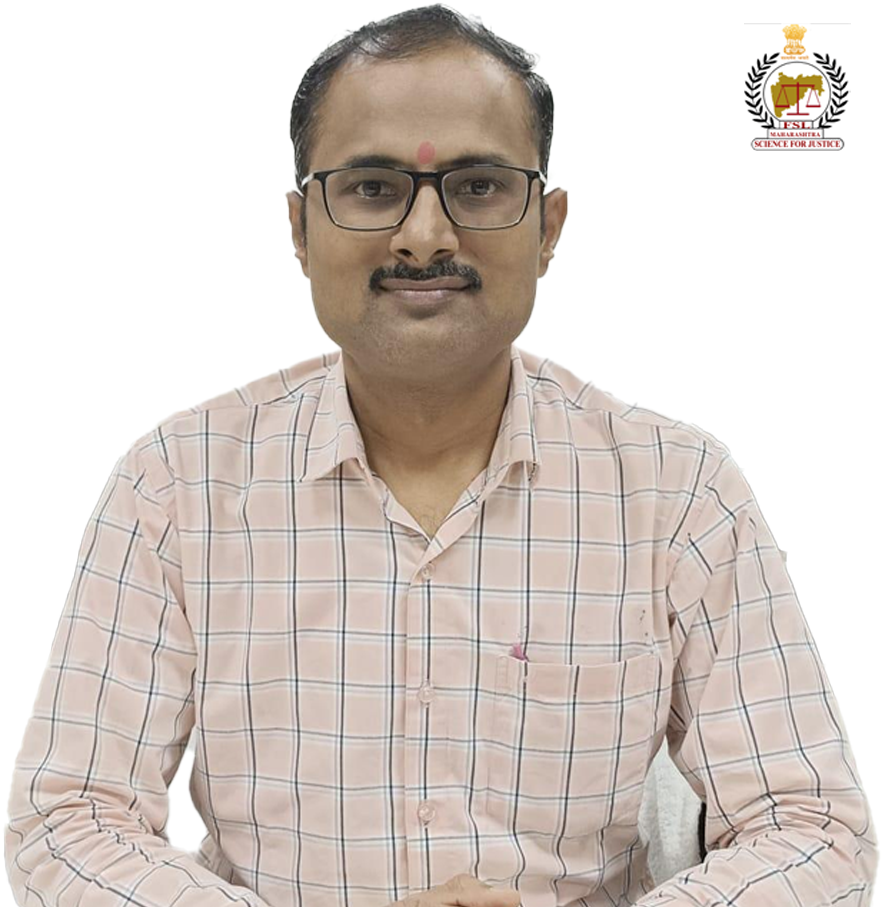
Division & Subject Head :
Dr S.R.Kote
Designation :
Deputy Director
Email :
[email protected]
Phone :
Key Evidence Types
Soil
Mineralogy, particle size, organic content for scene-to-suspect association.
Paint
Layer structure, binders, pigments for vehicle and tool contact evidence.
Glass
RI & elemental profile; fracture analysis for direction-of-force.
Metal
Alloy composition & surface marks; serial/engine number restoration.
Fibers
Microscopy & spectra for class/type; dye comparison and transfer.
Tool Marks
Striation & impression matching to suspect tools; class & individual traits.
Core Instrumentation
Atomic Absorption Spectrophotometer (AAS)
Elemental quantification in trace matrices (glass, metals, soils, paint).
Simultaneous Thermal Analyzer (STA)
TG/DSC for thermal behavior and binder/vehicle insights.
Energy Dispersive X-Ray Fluorescence (EDXRF)
Non-destructive elemental fingerprinting for class discrimination & sourcing.
Video Spectral Comparator (VSC-8000)
Ink/toner differentiation, alterations, and security features on forged documents (currency, stamps, stamp papers, lottery tickets, certificates, cheques).
Examination Workflow
Receipt & Triage
Registered with unique IDs; packaging & seal integrity verified.
Non-Destructive Screening
Microscopy/EDXRF first to preserve evidence whenever possible.
Comparative Analysis
Class & individual characteristics matched against controls/knowns.
Reporting
Clear, court-ready conclusions with method references & uncertainties.
Quality & Chain-of-Custody
Accreditation aligned; evidence logged across each transfer step.
Court Support
Expert testimony and demonstratives for clear scientific interpretation.
Applications:
Murder, theft, vehicle accidents, tampering & forgery, hit-and-run reconstruction, source attribution, and serial/engine number restoration in obliterated metals.